10 Things Anyone Under 40 Should Never Do

One of the recent trends on the internet seems to be articles listing things that anyone over 40 should never do, say, wear, eat or drink. In response, I would like to present my own list – of things that people under 40 should never do.

1) Never think 40 is OLD. It truly isn’t. 40 is just the beginning. You may have laid some groundwork before you were 40, but this is when you start living. And, trust me, you are going to be 40 way sooner than you think. 😂

2). Never think you should decide what people over 40 should wear. We are just people. We come in all sizes and shapes and tend to look our best in what makes us feel our best. Wear what makes you feel good. The rest of us can take care of ourselves 👙

3) Never think you are superior to us because technology comes naturally to you. People who are now over 40 pioneered the technical revolution. We, your parents, grandparents, aunts and uncles provided you with electronics from the time you were born. You grew up with them. I was working, as a bookkeeper when the first calculators came on the market. Wrap your head around that one. Not only have we had to evolve with our careers, we have basically had to evolve in a language that is foreign to us. 🖥️

4) Never tell people over 40 what they should eat. Health trends, diets and the science of nutrition evolves. Twenty years from now, hummus will cause cancer and people will realize that gelatin is a health food even if it makes your salad jiggle. Speaking of diets, there is no such thing as a one ingredient cookie. Freeze it, slice it, it is still a banana.🍌

5) Never believe that that the latest thing is always progress. Back in the day, we thought single use plastic bags and plastic straws were progress. 🥺

6) Never believe that you are more ethical than the generations before you. We did things that make you cringe? You were not there and have never been as culturally isolated as we were. We were not cruel, thoughtless, selfish or cold. We worked hard all week and gave generously to those in need around the globe. People devoted their entire lives to taking care of the sick, the elderly, the young, and the needy. People worked to support themselves and their families and then volunteered their free time and their talents to build their communities and keep them safe. Stop worrying about how terrible we were and start thinking about how much better you can be. 🤔

7) Never mock our fads and fashions, expressions and trends. We thought that they were as ‘cool‘ as you think yours are ‘lit’ . At least our fashion faux pas and embarrassing moments are stuffed away in yearbooks and wedding albums. Yours are going to live on forever, around the globe, compliments of social media.🙄

8) Never tell us what we should drink. Why do you care? I happen to enjoy tonic with my gin. Deal with it.🥃

9) Never believe that, just because your way is easier, it must be better. There is something to be said for “work smarter, not harder”. But, the operable word is still ‘work’. 👷

10) Never waste time resenting that we had things so much easier. We had things differently. We struggled, we faced challenges, we worked long hard hours under some difficult and dangerous conditions. Many of the industries that existed in our youth are virtually gone but there are others here and coming that did not exist in our day. We spent our money on basics – home and transportation, food and clothing. We did not have electronics, travel was a luxury, food was home cooked. Many of us took care of our elderly parents, physically and financially, and we still help our sons and daughters when they struggle. Few of us lived as well or as easily as you think we did. We did the best we could with what we had. 👍
Travel and Grandchildren

Genie At The Wheel

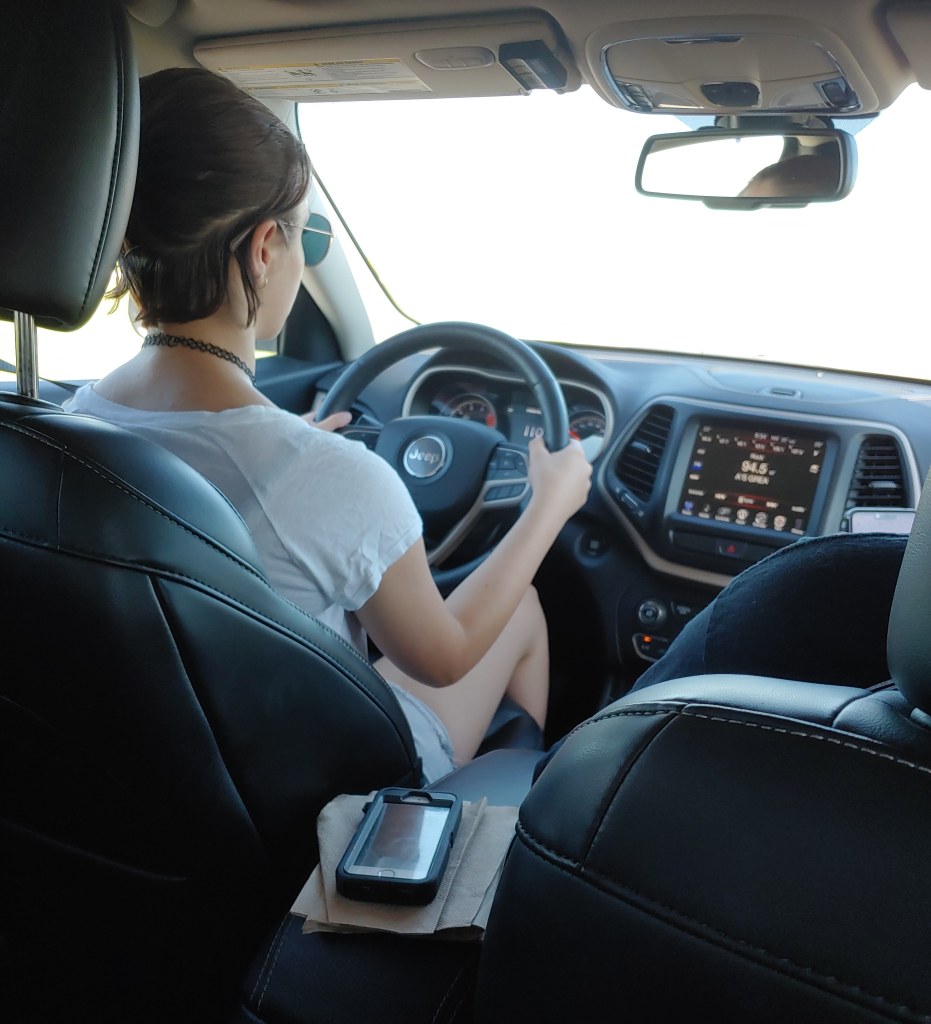
Two of the greatest pleasures of retirement are the freedom to travel and the time to spend with grandchildren. This summer, we were fortunate enough to combine the two. We packed ourselves and our teenage granddaughter into our new Jeep and set off on a trip to see my sister and her husband, and my son and his family, who live en route. Genie would travel with us as far as my son’s and spend some time with her cousins while we went on to our ultimate destination. We would pick her up on our return trip.

Since Genie had recently gotten her learner’s licence, Grandpa thought this could be a good opportunity for her to gain some on road experience. I had some reservations. We briefly discussed the matter but with Genie already buckled in behind the wheel and Grandpa firmly wrapped around her little finger, there was no turning back.

Saskatchewan does not have the most challenging roads on the planet. Genie was easily able to pull onto the highway, get up to speed and engage the cruise control. It soon became obvious that she has her mother’s confidence behind the wheel and the natural ability to keep it between the navigational lines. By the time she had a few miles under her belt and proven she could competently pass the slower vehicles on the road, we were all starting to relax. The time and miles passed.

Soon we were pulling into Saskatoon. There are two major cities in Saskatchewan, both with a population of about two hundred thousand people. We live in Regina and Saskatoon is the other. Genie had taken driver’s training in Regina. She had driven around the city with her driver trainer and on a number of occasions with her father. Since she had done so well on the highway, we were not worried about her driving through Saskatoon. We should have been. The first stretch was uneventful enough, Genie did fine inspite of the somewhat heavy traffic and the volume of vehicles merging into our lane. We were still at highway speed as we were taking the city bypass. Then, we took our exit and entered the actual maze of city streets. The speed limit dropped to fifty kilometers per hour. Genie did not. She was on a mission to get out of the city. She blew past our exit, so Grandpa had to guide her back through the traffic. He was doing a great job of keeping calm. Even when she inadvertently turned into a Costco parking lot, still going well over the fifty kilometer speed limit, Grandpa kept calm. Fortunately, all was well and she safely brought the Jeep to a stop. Once Genie and Grandpa had a chance to regroup and make a new plan, we were back on the road. Genie had the speed under control, she exited the parking lot, followed Grandpa’s instructions to turn left and drove straight ahead – oblivious to the red light in front of us. Grandpa convinced her to stop before she made it into the roadway. He was no longer quite as calm. I was on my last nerve but we reached our exit and soon we were out of Saskatoon.

An hour of open highway to North Battleford and we were ready to stop for lunch. We had the better part of an hour to relax and enjoy each other’s company before heading out. When we did, we came to a consensus that it was time for Grandpa to take the wheel – with Genie at his side, acting as chief navigator. Normally this would not have been an issue. Unfortunately our normal route out of town was under construction so we had to follow a somewhat confusing detour. After circling the construction site two or three times Genie successfully navigated Grandpa out to the highway.

The rest of the trip was enjoyable and uneventful as far as driving went. On our trip back it was obvious that Genie was too tired out from her visit with her cousins to drive so Grandpa drove the distance. We look forward to more opportunities to travel and spend time with all nine of our grandchildren once we are fully retired. Are we likely to put them all behind the wheel on our travels? That remains to be seen. However, this was certainly a special trip and one that we will always remember.

Aging Gracefully

A few years ago, when I turned fifty-nine, I created a vision board for myself. I had a passport (check), new SUV (check), pictures of a happy and growing hoard of grandchildren (check), an exercise routine (semi check) and a picture of a svelte woman – stylish white hair, perfect nails, perfect petite eyebrows, perfect tailored outfit and an overall look of confident and mature elegance. My husband asked who the woman was and I declared, “that is the future me”. He seemed skeptical but I had a plan to pull it all together.

My first step was to get my eyebrows under control. I went to a spa, explained to the cosmetologist that I wanted my eyebrows waxed and most importantly, that I am seriously allergic to tea tree oil. Four hours later, I came out of the emergency room with a bottle of antihistamines, a bottle of steroids, steroid cream and a couple of extra asthma inhalers for good measure. When the swelling went down and my eyebrows grew back, my daughter-in-law suggested I get my eyebrows threaded. That went well until my ‘threader’ finished my eyebrows and wiped my entire face with tea tree oil. Needless to say, the eyebrows are staying.

Next, I decided to focus on the svelte body. I exercised faithfully, invested in gym equipment and followed a great diet plan. I had two results. I lost ten of the forty pounds I needed to lose and I shrank down an inch and a half. I did, and still do, have the overall classic body structure of a Cabbage Patch kid.

With little graceful aging happening on the body end of things, I decided to work on my hair. It should be white, it would be white, had I not gotten into a serious relationship with Miss Clairol long ago. I warned my husband, who once again seemed skeptical, but said it was my hair. I warned my boss, who looked at me and asked what I planned to do with my eyebrows. Seriously? Anyway, I went home to Google ‘how to wash decades of dye out of ones hair’, as I was reluctant to go to a salon to be exposed to strong chemicals or, heaven forbid, tea tree oil. The short answer is, you do not wash decades of dye out of your hair. I tried a number of methods that weekend. I am pretty sure, my hair got darker. I finally broke down and went for a simple haircut, which somehow made me look less mature than when I started this make-over.

I still have the nails and wardrobe to work on. I am waiting for winter for the nails. Currently, I spend too much time digging in dirt with my bare hands to maintain a manicure. I could check out a new wardrobe anytime, but every time I go near a shopping centre I end up spending my money on the cutest clothes and footwear for my grandchildren. To be honest, at my age, do I really need to be trussed up in tailored, dry clean only, outfits? I rather enjoy my long sweatshirts, leggings and sneakers.

At the end of the day, I am not the woman in the picture on my vision board and I doubt if I ever will be. I am not svelte or elegant or perfectly coiffed. That has never been me, so why now? Retirement should be a time to be active and happy and comfortable with who one is. This is me and I am comfortable, so that is what I am going with.

Autumn in Saskatchewan

Autumn is bearing down on us in Saskatchewan. The days are shorter, the air is cooler and damper, the leaves are falling, and the trees and grass are fading to greige. For those not from the construction industry, ‘GREIGE’ is a color created by some sick bastard who thought grey and beige were not dull and depressing enough on their own. He, or she as the case may be, combined the two and greige became the official color of autumn in Saskatchewan.

Anyone not from Saskatchewan, could easily believe winter would be our toughest season of the year, That is not the case, at least not for me, and I have lived here for 64 years. Winter can be harsh, with our minus fifty days, but the majority of winter is spent indoors or in vehicles and we do have coats, hats, gloves and boots to protect us from the elements when we must venture out. Icy roads may be difficult to navigate, but to be honest, the ice pretty much brings traffic to a crawl, so driving is not as treacherous as one would expect. As for the mountains of snow, yes it is more than an inconvenience, as it tends to fall or drift where it is least welcome, but at least it is not greige. So, there is that. For those who are inclined to participate in winter sports, such as hockey, curling, tobogganing or cross country skiing , winter in Saskatchewan is probably a joy. I am not one who is so inclined, but I can deal with winter.

Winter has one absolute advantage over autumn. As we struggle to keep warm and mobile throughout a Saskatchewan winter, we know there is a light at the end of the tunnel. We know spring is coming, with blue skies, green grass, and warm sunny days. In autumn, we know that the only thing at the end of the tunnel is a Saskatchewan winter.

This autumn holds a special place in my heart. This will be my last autumn before I retire. This is the last season, where it will truly matter to me if the days get shorter and the nights get longer, if the air gets cooler or if the province is covered in a shroud of greige as I travel back and forth to work with the masses. Next year, when autumn arrives, I will have the option of curling up with my dog and a hot cup of tea in my cozy little home, ready to ignore it to my heart’s content.

Home Renovations

Early retirement is a time to rework our priorities. For most people, managing with less money and more time becomes a preoccupation of sorts. There is time to do many things we enjoy, but we have less money to indulge in them. On the other hand, while we have less money, we have more time to invest in cost saving ventures.

There are many ways to save money, if you are so inclined: home cooking, gardening, vehicle maintenance, and the ever popular home renovations. Most people have at one time or another been swept away by the call of paint or wallpaper, possibly new flooring or even a major landscaping project. A stroll through Home Depot or an hour watching the Home and Garden channel makes it appear easy and satisfying. Who couldn’t create a new set of cabinets with the help of a table saw and a good router? My guess would be about ninety percent of the living population, including myself.

There are some truly questionable home renovation projects out there. Wallpapering without removing electrical plates? Painting without taping around windows, doors, ceiling fixtures, and the like? Replacing eavestrough, without adding a drain pipe? They are out there and exemplify the difference between a successfully completed project and a renovation fail.

Tools are a crucial part of any project, and there is always a right and several wrong ways to use them. Ladders are a basic for most projects, yet people tumble off of them on a regular basis. There is a three point contact rule for ladders, use it. Be sure the ladder is anchored correctly and move it as often as required. Likewise, do not grab a running drill by the bit, operate an electric saw without a safety guard or use a grinder without proper eye protection. The proper tools can help bring a successful and professional completion to any project but they must be used correctly and safely. Read the instructions and follow them – especially when using a tool that you are not familiar with.

I do not anticipate investing a lot of time, or saving a lot of money doing home renovations when I am retired. Over the years, I have learned that paint, wallpaper and caulking are not my friend. Tape is definitely not my friend. To be honest, I am not on particularly good terms with tools, either. However, for anyone so inclined, retirement can be a great to tackle those home improvement projects, to save you money and to give you that sense of accomplishment you may be missing since retiring.

Pets and Purpose

Developing a routine, in a totally unstructured situation, like retirement, can be difficult as well as necessary. If you are like me, you require a routine to keep your priorities in order. My annual holiday typically begins with a plan for completing at least one relatively major project around the house. Since I have two weeks off, this would seem doable. Except, since I have an entire two weeks to do as I please, I am more than willing to procrastinate on my project while I enjoy the freedom of following any and all distractions that come up. By the end of my holiday, I have been on a couple of short trips, enjoyed taco and pool parties with the grandchildren, read at least a couple of books, and spent hours wandering around Home Depot for no particular reason. Meanwhile, our cupboards are still disorganized or our guestroom still needs a fresh coat of paint. Which bring me to the importance of having pets.

My husband and I have always had pets in our home. I came with a dog named Scraps and Dan came with a cat named Hank. Shortly thereafter, Scraps had to be put down and we both agreed we did not really need or want another dog. We lived in a small house, wanted the freedom to travel and we both worked fulltime so getting another dog just wasn’t practical. Until, my husband worked a few of his regular night shifts. Older homes make disturbing sounds and cats really could care less. The Hell’s Angels could be coming in the back door and Hank would be curled up sleeping or silently prowling around, up to his own devices. So, we got Casey. For unknown reasons, Hank had a stroke the next day and had to be put down. We definitely did not need another cat! Until, my daughter brought over a tiny blind kitten desperately needing a home. So, we got Suzie. Suzie was a sweetheart but when she was about twelve years old, her health deteriorated and we had to put her down. Casey seemed rather lonely, but she was ok and I had just suffered a major health issue which was in part due to my allergy to cats. We decided we definitely were not getting another cat. Until my boss had to put down his Golden Retriever, Jody. There are not enough words to describe how thoroughly heartbroken he was. At this point, Dan and Casey were inseparable. Casey was an amazing dog – smart, empathetic and loyal. She was aging and seeing how my boss was hit by the loss of his Jody, I decided to get pro-active and convinced my husband we should get a back-up dog. So we got Kat. (Who is a dog – a Cavelier King Charles, to be precise). She did not lessen the pain of losing our beautiful Casey a couple of years ago, but she has definitely made a place for herself in our hearts and in our home.

With retirement approaching, we have discussed getting another dog. Our pets have been invaluable over the years – for love, companionship and security – and for holding us to somewhat of a routine, even during holidays. Pets do not care if you are willing to sleep late, they eat at six a.m. and will harass you until that happens for them. Supper is the same. You may be willing to wait – your dog is not – or at least, our dog is not. Dogs do not care if you want to curl up in front of a television after supper, they want to go for a walk. Pets have a routine and they will hold you to it, which is a good thing when you are in an unstructured situation.

Chances are we will be bringing another dog (or dogs) into our home. We may adopt an older dog, missing the adorable puppy stage and the extra responsibility that involves. We may even choose to foster, instead of committing to a long-term relationship with one dog, depending on how we are holding up. But, I definitely believe we will have a dog in our life for years to come – filling our home with love and helping to keep us on a schedule which includes a healthy dose of exercise and fresh air and enough responsibility to help us feel needed.

Before Retirement: Life in the Construction Industry

I am looking forward to retirement. I am ready to have time for me. I am ready to be free of the 8 to 4:30, Monday through Friday workweek. I will not miss driving to work in the pitch dark on icy streets. I will not miss the lunchbag sandwiches, salads and soups. I will not miss being tied to a desk for eight hours a day, seeing the sunshine on the other side of the street. There are a number of things I will not miss, and there are many things that I will.

For the past twenty-five years, I have worked in the Saskatchewan construction industry. I worked at a millwork company that made amazing custom cabinets, a metal company that did phenomenal work in stainless steel, brass, aluminum, and steel, and for the past fifteen years I have worked for a company that sells and installs high end residential and commercial construction specialty products. It has been fun, interesting and gratifying.

The best part of the construction industry is the people. For the most part, I have loved working with the clients, consultants, contractors, suppliers, my bosses and co-workers. We are all a part of an industry, and the heart and soul of our industry are the tradespeople. They work through the blazing heat of summer and the frigid cold of winter. They work the hours it takes, and do what they have to do, to get the job done. At the end of the day, they are proud of what they have done. It is not just about a paycheque or personal accolades. It is a house or a hospital or a school that they helped to build, as part of a team of dedicated professionals.

The construction industry has gone through a lot of changes in the past twenty-five years. Some changes have been good, like improvements in products, design and equipment. Some changes have not been as good, in my mind. There have been a lot of new or revised programs that have added a lot of administration but little value to the industry.

Today I attended a meeting focused on digital transformation in the construction industry. It was primarily a presentation of a program designed to manage the administration and documentation of major projects. From what I could tell this particular program seemed credible.

My issue with this meeting was the pre-presentation warm up. The speaker noted that the construction industry is far behind other industries, such as manufacturing, in developing and implementing the technology required to ‘progress’ . He showed a number of small clips, most of which I had no real issue with. He had one on BIM software, one on Robotics, one on drones, one on virtual reality – all of which could be legitimately used as tools to enhance construction projects and deal with issues before they become real life brick and mortar issues.

Than he showed a clip on AI – artificial intelligence. This clip explained how technology could be implemented to constantly scan a worksite, count and record the vehicles entering and leaving the site and scan the workers from the time they step on to the site to the time they leave. It would scan where they went, what they did, record any safety infractions, check their ppe (personal protective equipment), etc. I voiced my objection to technology being used in this manner.

One of the other attendees noted that it is frustrating to constantly be monitoring workers for proper use of their ppe and that this could be a safety management tool, which the presenter quickly agreed with. Except, it would not really help to improve safety on a site. If someone was monitoring this scanner every moment, and if they saw a safety alert pop up, they would have to contact someone on the site to go address the situation. This would still be an ongoing issue for foremen and supervisors to deal with. What this technology would do, would be to provide a record so that if there was an incident, the contractor could go to court, backed with video proof of what part a worker had played in the incident and use it to mitigate any legal responsibility the company would have.

We all want everyone to go home safe at the end of the day. Workers do not want to be injured on the job or anywhere else. For the most part they are conscientious about safety – theirs and the people they work with. However, workers are human. They are working in situations that are not ideal and under conditions that are problematic. They are working with dangerous tools and with product that has the potential to turn lethal in a gust of wind or a slight miss-step. Accidents do and will continue to happen. When they do, injured workers and their families should be taken care of. That is what worker’s compensation and disabilty insurance is for.

Artificial intelligence that is implemented to dehumanize our workforce is not progress. Technology used in this manner is an appalling insult to the front line workers in our industry. Next summer, this will no longer be ‘my industry’ but I hope that those who remain will ensure that it remains an industry where workers are treated with respect and appreciation.

Elmo

I have been reading various books, searching for advice on how to make the most of my upcoming retirement. One gets into a routine, working five days a week – forty nine weeks of the year – for decades . Building a new routine that will keep my mind sharp, my body healthy and my emotions upbeat, in an unstructured environment, is going to take some effort.

A few days ago I started reading “The Alter Ego” by Todd Herman. The first few chapters were a bit difficult to get into. This book seemed a little clinical and academic to me and probably not what I was looking for, as motivation goes. I was also fairly dubious that Mr. Herman was going to get me to a place where I could believe I had this alter ego, super hero, in me. To be honest, I am not there yet – or to the point in the book where Mr. Herman explains how to find or create one’s own super hero.

I have however gotten to the chapter where Mr. Herman explains how to deal with negative inner dialogue. That is an issue I have struggled with for years. “I am not smart enough – strong enough – graceful enough” “what if I fail – what if, what if, what if “. I have read enough self help books to know this type of inner dialogue is not helpful. Knowing that and ridding myself of it, has been another story. But Mr. Herman offered a unique approach.

Mr. Herman identifies this negative inner dialogue as coming from ‘the enemy within’. He explains how giving this enemy a name, a personality and a physical appearance, gives you the power to vanquish it. This was an ‘aha’ moment for me. Out of the blue, I thought “Elmo, F…. off”. I’m not the type to be crude, so that was rather shocking and I have no idea why Elmo, but it worked. All of the ‘not enough’s and ‘what if’s’ vanished and I am hopeful that if, or when, they return I will have the power to silence them.

Obviously, I am going to finish this book and maybe I will even find my alter ego. Honestly I am happy just enjoying my newfound confidence and peace of mind with Elmo and his chatter gone.

If you are trying to get a handle on a situation in your life, I would recommend this book – “The Alter Ego” by Todd Herman. Actually, I would recommend Elmo, too. He’s always been a favourite with my children (when they were children) and their children.

In My Own Mind

As with anything else in life, retirement is pretty much what you make of it. Regardless of actual circumstances, there are people who enjoy it and make the most of it and those who are miserable.

People who have typically been happy and content throughout life, have little trouble adjusting to retirement. They take it upon themselves to find ways to keep active, which will in turn help to keep them healthy. They use their time on worthwhile and satisfying endeavors, they keep engaged and in touch with their family, friends and community. And finally, they take a sensible approach to their finances, ensuring that they live within their means.

On the other hand, if someone has been relatively miserable throughout their life, clinging to a victim or poverty mentality, blaming others for challenges in their life and making others responsible for their happiness and well-being, then retirement is not going to go well for them . They are on a collision course with declining health, a deteriorating mind, loneliness, boredom, depression and financial issues

If you have gotten into the habit of being pessimistic and miserable. it is never too late to change. These days, it seems that many seniors take pride in being miserable, like it is a badge of honor. It is not. It does nothing for you and nothing for those around you. It is not anyone’s responsibility but your own to make your life, at any stage, meaningful and pleasant. If you do not know how, start reading. There are numerous self-help books available. They may not be geared towards retirement and not every one may be as meaningful or as helpful as others, but if you keep reading and searching, you will find helpful advice. If you are not inclined to read, take a walk or do anything positive and pro-active. Start taking responsibility for your attitude and you will find that you ultimately have the power to improve your life.

If you are the partner of someone who tends to be miserable, you need to know that you cannot make someone else be happy if they choose not to be. You can destroy your own happiness and contentment trying and they will be no less miserable. You may believe you are making them happier by sacrificing your needs for their wants, because they are momentarily happy to have what they want, but that does not make them happy. That just encourages them to keep being miserable to get more of what they want. Couples spend a lot of time together in retirement. If your partner is the type to be miserable, you need to make it very clear that you are not responsible for their happiness so they can address their issues.

If you or your partner are typically happy and well adjusted, a sudden change in attitude could be brought on by medical issues and should be checked out by a professional, sooner than later. Even if a serious medical issue is found to be the problem, it is ultimately easier and less stressful to actually know what is causing the problem and deal with it, than to deal with the unknown. Once you regain control of your mindset, you will be back on track for the retirement you deserve.

Habits

We all have habits that we have developed over the years. Much of what we do is so routine that we do it with little thought or even much effort. This can work for us, or against us.

For those of us embarking on our retirement, it would be reasonable to take a look at our everyday habits and decide which ones to keep, which ones to lose and which ones to create.

We have developed some good habits over the years, many of which would still serve us. Most of us have a morning routine that we follow – get up, make our bed, freshen up – just the basics that help us to prepare for the day ahead and to motivate us to feel ‘ready’. It worked in our working life, it will work in our retirement. There are other habits, that were good, but were tied to our work routine. These we will no doubt have to change to fit our new lifestyle. If we have a physically demanding occupation, that may have covered much of our exercise requirements. Now we will have to create a new workout routine to ensure our health and fitness. If we have a more mentally challenging career, we may have to add more mental stimulation to our daily routine, to keep our minds sharp as our home life rituals may have been more focused on the physical.

We all have habits that have never, and will never, serve us. This is an excellent time to make note of these and rid ourselves of them. These could include indulging in take-out or processed food on a regular basis, watching too much television, smoking – anything that is likewise just unhealthy and a waste of time and/or money.

Finally, this is a great time to focus on building new habits that will serve us during this phase of our lives. These might include starting a new exercise program, reading, cooking, socializing – just creating routines that are mentally. physically and emotionally stimulating and satisfying. Retirement can be some of the best years of our lives, but as always, it is up to us to make that happen.

It can be difficult making or breaking habits. I recently read “Atomic Habits” by James Clear. This book was a complete game changer for me. It is an easy read full of helpful tips and advice that make sense. Personally, I believe anyone preparing to retire should read it. It was certainly worth my time and money.